By: Clare Buchanan
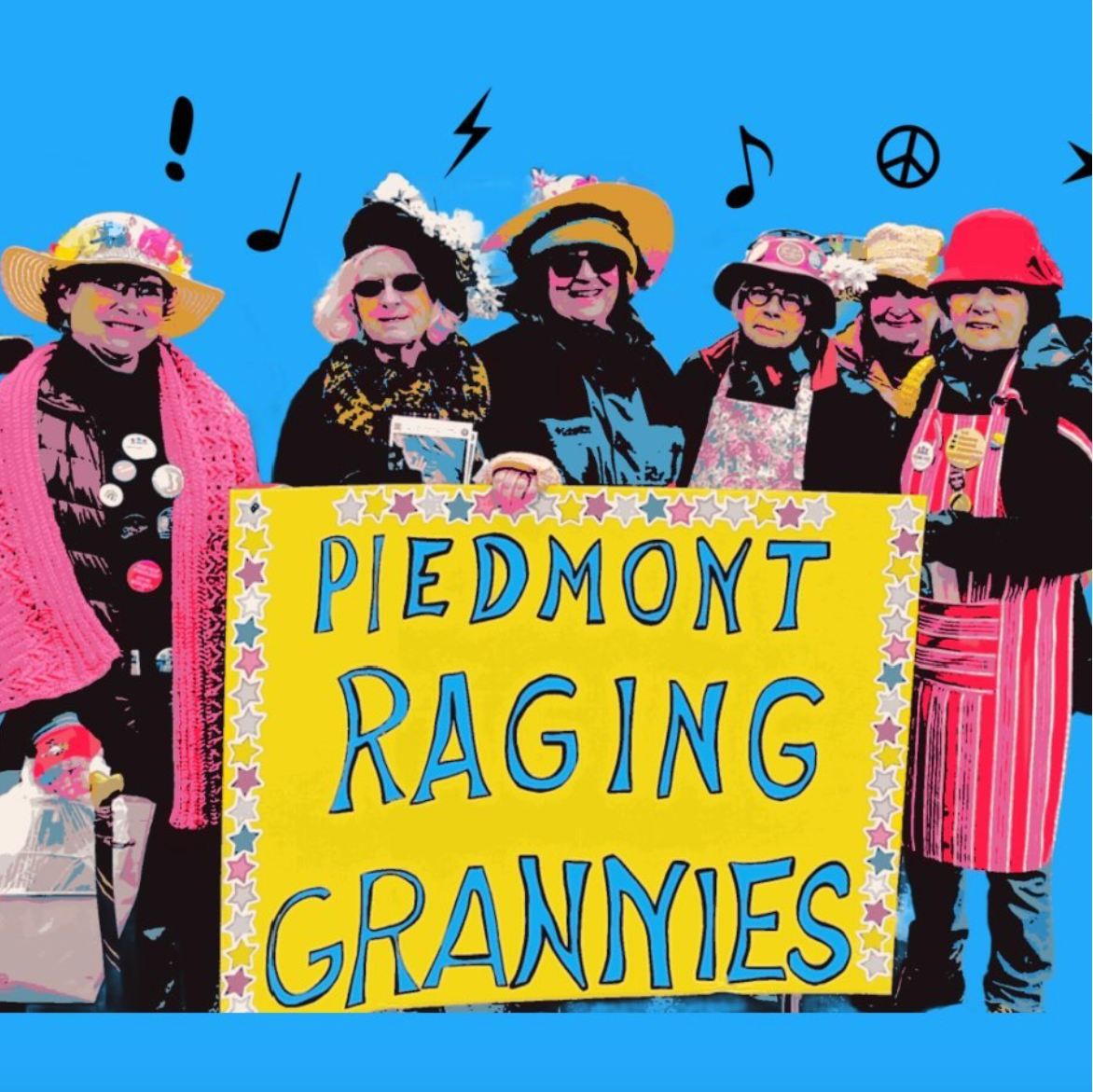
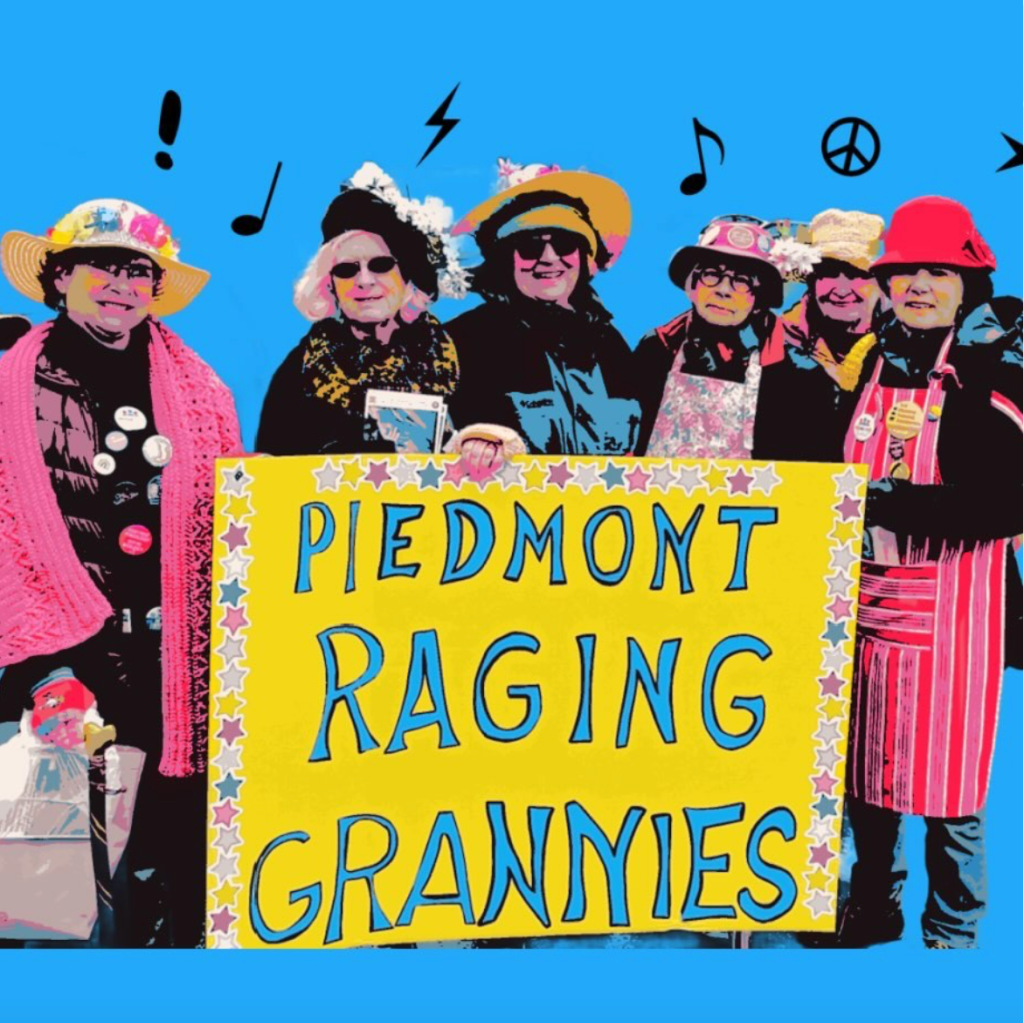
Photo Credit: piedmontraginggrannies on Instagram
Piedmont Raging Grannies Take On Trump Administration Through Song
On November 21, I got the opportunity to interview a few members of The Piedmont Raging Grannies, a local chapter of a larger international organization originally founded in Canada in 1987, the Raging Grannies. Brought together by their desire to voice their political opinions through cheeky yet impactful protest songs, the Piedmont Raging Grannies have been making waves both in the Triad and nationally. The Piedmont Raging Grannies have become a national sensation, appearing on Rachel Maddow’s MSNBC Town Hall feature in March of this year, captivating audiences with their boisterous hats, political pins, and colorful sashes. Most importantly, viewers have been drawn to the messages of their protest songs, which are often sung in groups with the help of one or two song leaders and a few instruments like a ukulele. The Piedmont Raging Grannies’ message is clear: they are dissatisfied with the current federal administration, and they want the world to know about it.
Since March, the Piedmont Raging Grannies have posted around twenty protest songs on their YouTube, as well as attended rallies across the state, including the No Kings Protest in downtown Winston-Salem in October as they expressed their frustration with the current president, Donald Trump.
When I sat down to discuss with the group their motivations for coming together in song, how their lives have led them to the Raging Grannies, and what their message was for Salem College students, I was pleasantly taken aback by these women’s candor, moxie, and outright grit and determination.
The Salemite: What is the origin story of the Piedmont Raging Grannies, and how did this specific chapter come to be?
Granny Lyn: The Piedmont Grannies are international; I don’t know if you know that. They started in 1987 in Canada when there were some little old ladies in Canada who were pissed off. They were writing and signing petitions and calling their members of Parliament, all the stuff you do, to get rid of those nuclear vessels. They weren’t being listened to, so they went back and regrouped and thought, you know, if they won’t listen to us when we talk to them, maybe they’ll listen to us when they sing. So they started dressing like this—and put progressive protest lyrics to all the familiar songs, and they made a difference. The Triangle Grannies have been here for twenty years, but we are new. We have only been around for two and a half years and we are loving every minute of it. How we came to be is the Triangle Grannies—there was a demonstration, a protest, or a rally or something in downtown Greensboro, and the Triangle Grannies came and sang. And someone—I think it was Nan—passed around a sign-up sheet for those of us who were interested. Of the grannies who are here, Nan and I are original Grannies. And Margie, were you there too?
Granny Margie: I was there, but I didn’t sign up. I was recruited.
Granny Lyn: You were recruited, okay.
Granny Margie: I was recruited, and not being able to sing was not…
Granny Lyn: It’s not a deal killer.
Granny Margie: It certainly is not.
Granny Lyn: Some of our Grannies have absolutely gorgeous voices, and some…can carry a tune.
How did each of you decide to join this group?
Granny Fifi: I saw that same performance of the Triangle Grannies, and I was one of the first ones to sign up as well. I had done a bunch of different kinds of political protests or political involvement over the years here and there—and I’m a singer-songwriter and play guitar and ukulele, and so this form of protest felt right up my alley, and I was so excited to get started.
Granny Lyn: And Granny Fifi was our first ukulele player.
Granny Margie: She was our first musician, period.
Granny Lyn: Exactly.
Granny Margie: And I was working in an office with fellow political activists, and two of them were in the Grannies and asked me, “Why aren’t you in the Grannies?”, and this is something I’d heard before in college. You know, “Why aren’t you in Glee club?” And when they heard me sing, that was the end of me being in the Glee club. So, they had me sing “Row, Row, Row Your Boat” and evidently, they liked—they pretended it was good. It was supposed to be a relief from the tension we were feeling working in politics. It was supposed to be a fun…what do you call it? Pressure release. And well, it turned out to be a lot more than that.
Granny Naan: I’m going to go backwards a little bit more, how this gaggle got started. I put out the clipboards to gather the names in Greensboro. It was just a couple weeks before that, that a member who is no longer with us, and I went to Raleigh. We were at a protest, and the Triangle Grannies sang. I was clueless; I didn’t know about the Grannies. I was enjoying the music; they had written their own music, very political. And I was like, “We need this in Greensboro!” And we were planning a reproductive rally in a couple of weeks, and so I asked them if they’d come up and sing for us, and they agreed. Most of the people there were really taken with them because they were very good, and that’s when I said, “Would you like to have a chapter here?” And so we put out the clipboard and got about twelve signups.
Granny Lyn: And now we’ve grown exponentially. Granny Fifi has been posting to our social media sites. Did you know we were on the Rachel Maddox show?
Buchanan: You are joking, really?
Granny Lyn: That was our exact reaction.
Buchanan: Wow, that is fantastic.
Granny Fifi: Back in March, we wrote and sang a song at an event, a town hall for Tom Tillis, of course we invited him, and he never comes to them. So we wrote a song, “Oh, Tillis. Do Your Job!” And we got the audience involved singing with us, and Rachel Maddox just happened to be doing a series of town hall features on her show, and she gave us quite a segment. And that’s when we went viral. And now our accounts are being shared by people like Cynthia Nixon, Mark Ruffalo, and Rosie O’Donnell. It’s been quite a ride.
Buchanan: That’s amazing.
Granny Margie: We also made Fox News.
Granny Fifi: Oh yeah, Fox News had us on to pick on us.
Granny Lyn: They definitely picked on us. They scorned us.
Granny Margie: It backfired.
What was that like, being seen on a national level? Both on Rachel Maddox and Fox News?
Granny Fifi: We could not believe it had happened, and it literally happened overnight. It just kept going up from there, to the point where our social media accounts had over 4 million views a month.
Granny Naan: We were getting invites from other states.
Granny Fifi: And other countries. We’ve been asked to go to Liverpool, England, and to Germany, and to California.
Granny Lyn: And people have asked us to make a recording, I mean, a record. People are responding. And we think it’s making a big difference, and other gaggles have been formed around the country because they’ve seen us. It’s great.
Granny Fifi: There have been a lot of women on social media who have said, “I want to do this. How can I do this?” And we always send them to the international raging grannies international website so they can find a location where there might be a group near them, and there’s also a starter kit if there isn’t to start their own gaggle. And we actually crashed the website, and they had to upgrade the website to deal with all the extra traffic. It’s really been something else.
Granny Meg: I’m probably the newest member here. I saw the Grannies at the No Kings protest in Greensboro. They were marching around and singing on a street corner, and I was just like, “Oh man, I want to do that.”
Granny Linda: My husband and I have been politically active for a while, and I don’t know why I had never heard of the grannies, but someone mentioned the Raging Grannies, and I said, “I don’t know who they are or what they do, but that’s me.” So someone gave me Lyn’s number, and I think I texted Lyn and I said, “I want to join your group, what do you do?” And they said, “We sing protest songs!” And I said, “Well, that really is me then!” It’s a perfect fit. I’ve found my people.
Granny Fifi: And Linda is one of our song leaders now. She has that musical background and she’s been very helpful in guiding us with the music.
What are some of the group’s favorite songs to perform, and why are they meaningful to you?
Granny Meg: I think “You’ve Pissed Off Granny” is sort of a classic that is everybody’s favorite and kinda epitomizes who we are. I have to say every song is my favorite song when I’m singing it. We just had a rehearsal, and we did three or four new songs and I was like, “These are the greatest songs. These are the greatest words.” It really expresses how I feel. Every song is great, and the people who write them—it’s just so clever and wonderful. How can you pick a favorite child?
Granny Fifi: “You’ve Pissed Off Grandma” is also one of my favorites, as Lyn always says as she introduces it at the events we sing at, it’s her favorite because it lets us talk about all the things we’re pissed off about. And even the title generates a laugh from people and gets their attention. We get to talk about all the things that we see that are wrong and need improving on in society, but with some humor. It gives us a way to inject humor into a very serious situation, and it really resonates with people. During the summer of last year, before the election, Margie wrote a wonderful song called “Project 2025” and that just outlines all the things we were warning people that were coming.
How has humor helped this group express your justified rage against this current administration?
Granny Linda: I think that it is a powerful medium. Like John Stewart and Stephen Colbert, who are now very popular, using humor to point out the absurdity in some of our politics is important, and I think we do that. I think that’s one of the things we do as Grannies.
Granny Margie: I think that humor lifts people up, it lightens you. You feel lighter when you are laughing. And for people that like to make people laugh, the biggest reward you get is when people laugh. No one can tell you what’s going to be funny and what’s not. You always take a chance when you make a joke; you don’t know how people are going to take it, and there’s a little bravery involved in that.
What are some of the biggest issues that you hope the Piedmont Raging Grannies can bring light to in your communities?
Granny Fifi: The song leaders and I had a conversation last night, and we were talking about the importance of addressing through music the fact that ICE is now in North Carolina, and that we’ve got to get out there in the streets and sing our songs and make some more videos. That is very top of mind, and we’ve come up with a few ideas to get started. We like to address local issues, and regional issues, and national issues. We find ourselves in a national crisis, and there is a lot to sing about.
Granny Linda: On the 8th, we are going down to Asheboro, where the Moms for Liberty is trying to take over the Library Board, not the school library, but the public library, because they want to ban a particular book. We haven’t done this issue before; it’s a new issue for us. But it’s important.
Grandma Naan: Margie has worked, I don’t know how many years, on Medicare for all. That’s a big issue for her, and she has these connections with health groups. We do a lot of songs on needing Medicare, needing insurance, all that. We have also done songs on gun control or gun legislation.
Granny Margie: We’ve done reproductive rights. It’s almost annually we do that.
Granny Fifi: LGBTQ+ issues. We’ve got lots of songs about that. Environmental issues. We sing at a lot of those events.
Buchanan: I noticed you have a pin against the Transco pipeline.
Granny Fifi: Yeah, we’ve sang at a couple of those events.
Buchanan: That’s a current issue that is affecting a very local community.
Granny Margie: We sang. We sang to the board that was going to make the decision about the pipeline. We actually went to the podium and we each sang a song.
Buchanan: What was that experience like?
Granny Naan: It was a public comment.
Granny Fifi: We gave our public comment in song, and we weren’t sure how it would be received, but it went over really well. People appreciated it.
I want to talk a little bit about the No Kings Protest in Downtown Winston-Salem in October. What was the Piedmont Raging Grannies’ role in that protest specifically?
Granny Naan: They gave us three or four songs to sing. We ended up singing what, about eight?
Granny Linda: Yeah, I think it was six.
Granny Naan: And 3,500 people showed up.
Granny Margie: We also reinforced the speaker’s opinions and got the crowd engaged and singing with us. For example, one of the last speakers was saying, “We’re not going back, we’re not going back.” So we pulled out our song, “We’re not going back,” after he spoke, and that’s what we like to do, we like to be integral in the program by working with the event organizers so that we are amplifying their message and ours as well.
Granny Linda: I second everything that Naan and Margie said. It was an exciting event, and we added to that. Like Margie said, we reinforced what the speakers were saying. Everything we planned to sing went along perfectly with what people were saying.
Granny Margie: People seem to love the character of the raging granny, they really do. We’re actors. It feels weird, you know?
Buchanan: Yeah, it’s almost like a character when you put on the costume, right?
Granny Margie: We’re definitely characters.
Granny Fifi: It’s meant to be a caricature of this sweet little old lady so that when these words come out of mouths, people are like, “Oh!”
Granny Margie: Well, you know, some of us had grandmothers like that.
Buchanan: Oh yeah. I know mine was like that.
Granny Margie: Yeah, feisty.
What is a message you’d like to leave Salem College students with?
Granny Fifi: I’d just like to say there are many ways to protest and resist and get involved. The arts have shown over history to be hugely important in political protests. At any age, there is always a way. There’s a group that follows us on Instagram called “The Insufferable Wenches of Iowa,” and they’re a younger female group. I just love that that’s what they call themselves, and that they’re a young group.
Granny Naan: I’ll echo that. Get involved. Stay involved. Make sure you vote. Find some way to protest or resist that you’re passionate about, whether that be singing or writing letters to the editor or senators, to whoever. Get out in the streets. Show up.
Granny Fifi: And you will create community that way. You’ll be a part of a community that supports each other and lifts you up; it’s a wonderful feeling.
Granny Linda: I would say, never give up. Most of us were protesting when we were your age. We were protesting for civil rights, women’s rights. A lot of us probably coasted for many years, but now stuff has come up again, and here we are. Protesting some of the same stuff we protested in the 60s and 70s. Never give up, don’t flag. Keep going.
Granny Margie: There is a period of time you start out very idealistic. And then you wind up trying to start a family, trying to keep the food on the table, a roof over your head, never knowing when you’re gonna get that pink slip and you become cynical. But, you can overcome that when you’re older. Please, don’t give up. Keep trying. Don’t lose your sense of right and wrong by becoming cynical. Every one of us probably had a period in our life when we did that so stay true to who you are. When you become older, you become freer. It happens faster than you’ll know. You’ll be old like me before you know it.
Granny Linda: And don’t count out the old people. Because you hear a lot on TV, “Oh, it’s just a bunch of old people protesting. It’s just a bunch of white hairs.” Well, honey. We made you.
Granny Fifi: And we vote!
Granny Linda: And there’s more of us as just about any other group.
Granny Fifi: And we have the time now, to do this work.
Granny Margie: And we don’t have to worry about some employer not hiring us because we’re all over FOx News and Rachel Maddox. We have a very important role to play because we’re speaking for the younger generation.
Granny Meg: But don’t wait until you’re old to think that you can do this. We probably all protested in some kind of way in college or wherever, so you’re the ones who will be living with the consequences with whats happening far longer than we will. So, just don’t be passive. Don’t think there’s nothing you can do, because you can. Even if you call your representative or vote or get your friends to vote, don’t be passive.
Granny Fifi: Everybody has a lot of power as a consumer, we need to be thinking about that, what our money is funding.
Buchanan: That’s a great point.
Granny Margie: As a young person, what do we mean to you?
Buchanan: Oh my gosh, wow. That is a really special question. I think I find a lot of hope in generations older than mine who did in the 60s and 70s fight for a lot of the rights we have now, that are under attack, but I just…I guess it helps me see a pathway forward when I struggle to see what my life will look like as I age and what will be possible for me in my career, what will be possible in terms of if I’m able to have a family or not. I think seeing older generations like you standing up for what you believe in and having this moxie that is so whimsical and empowering and that’s why I wanted to interview you because I wanted my fellow Salem College students to also have some of that hope.
Granny Margie: We’re doing it for you.
Buchanan: Yeah. Wow.
Granny Margie: We don’t want to leave this world in a mess. So we do humor, but we’re absolutely serious about what we’re doing.
Granny Lyn: I wanted to echo what everybody said to keep going but one of the things I hadn’t thought about until recently is that if you talk to young people who are despairing, that is part of fascist playbook. We need to not do what they want us to do, which is to despair and feel overwhelmed and give up.
After my conversation with the Piedmont Raging Grannies, I took some time to sit with their words, their message, and their unique approach to political activism. A few things were clear; creative uses of political activism can be inspiring and captivating. Bridging gaps between generations really revolves around conversation, and sharing our stories with each other. And lastly, one cannot give into fear. Because like Granny Margie said, there is a certain humor in the absurdity of politics. And when an endearing looking granny dressed in her Sunday best puts her fist in the air and demands for justice- we must listen.
Visit The Salemite’s youtube, @TheSalemite, for the full video interview.
 The Salemite- Salem College's Newspaper
Leave a comment