By: Clare Buchanan and Hailey Phillips

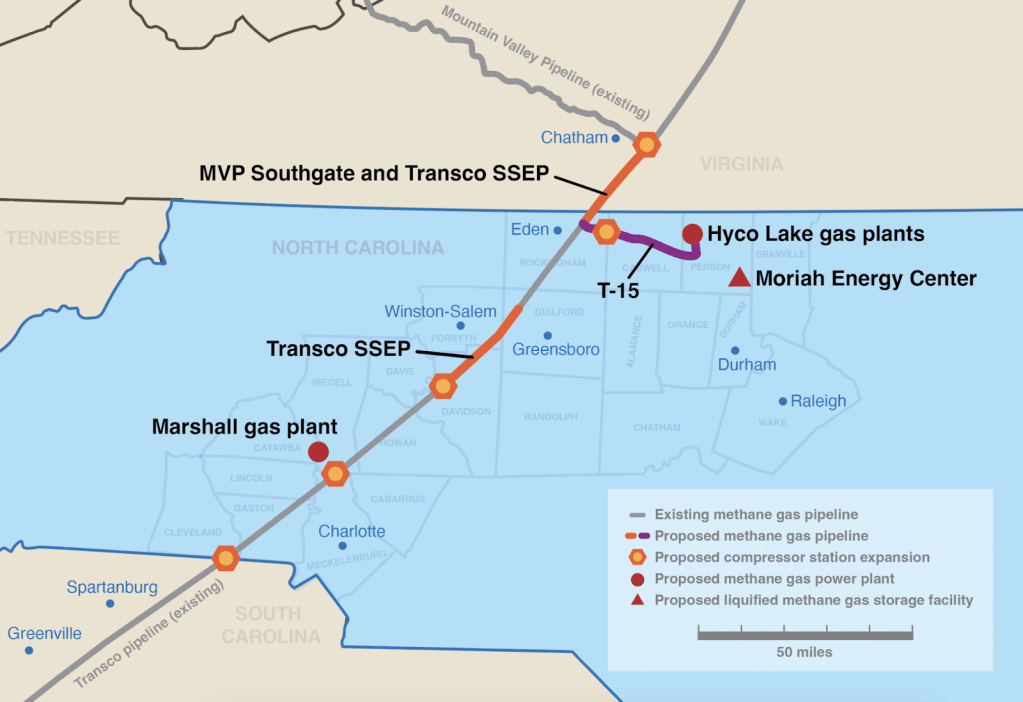
Photo Credit: NO SSEP Action Toolkit
According to the Southern Environmental Law Center (SELC), the Transcontinental Gas Pipe Line Company, commonly known as “Williams,” has sent in an application to the Federal Energy Regulatory Commission (FERC) to extend the transcontinental pipeline further into Virginia, Georgia, and the Carolinas. If approved, this expansion, which has been termed the Southeast Supply Enhancement Project (SSEP), could go straight through the Triad. FERC is led by members appointed by the President of the United States and then confirmed by the Senate.
As explained by Winston-Salem’s local nonprofit radio station, WFDD, FERC had two options when reviewing the proposal sent by Williams. The first was to undergo an environmental impact statement, which involves direct feedback from the community and a more in-depth analysis. The second was an environmental assessment, which is “more surface-level by design.”
According to nossep.org, on Jan. 22, 2025, FERC announced it would go forward with the latter option, signaling a change in federal policy norms where large-scale environmental decisions, such as expanding pipelines, are being evaluated at a “surface-level.”
In an interview previously published by The Salemite in Feb. 2025, Editor-in-Chief, Clare Buchanan, was able to ask Deirdre Dlugoleski, Associate Attorney at the Southern Environmental Law Center, a few key questions about the issue:
Buchanan: The SELC has stated in an article that the Transco expansion project will bring “33,000 megawatts of new gas-fired energy capacity by 2038.” However, the SELC has also stated this energy will not be for homes, it will be for data centers. Could you explain how this would affect the lives of people living near the pipeline?
Dlugoleski: “From our research, it seems overwhelmingly likely that the gas Transco hopes to transport with the Southeast Supply Enhancement Project (SSEP) will ultimately power proposed power plants in the region, which in turn are being proposed and potentially approved
to power the forecasted demand of potential data centers. That simply means that the communities and people who will bear the harm from the project, like landowners who will lose property through eminent domain or communities whose water supplies are damaged
and/or air polluted from construction and operation, will generally not see the benefits from the project. Essentially, large companies will benefit to the detriment of the people and communities who live along the pipeline route, as well as consumers generally within the state of North Carolina, as this project will lock us more into yet more fossil fuel use for years to come.
For accuracy’s sake, it’s important to note that Transco is both expanding the capacity of its existing pipe and building some segments of a new pipeline. The expansion of the existing line’s capacity comes from adding power to compressor stations, which are above-ground facilities along the pipeline route that add pressure to the gas to make it move through the pipeline (think of squeezing a tube of toothpaste). While some of the compressor stations Transco plans to expand run on electricity, two of them (both in North Carolina) run on, and will be expanded with, gas. This will increase the air pollution these stations emit, which will in turn negatively impact the people living closest to the stations. These two North Carolina compressor stations are in Mooresville and Lexington.”
Buchanan: North Carolina has passed a law that aims to lower carbon dioxide emissions by seventy percent from 2005 levels in the next five years. How will the Transco expansion project affect these long-term goals?
Dlugoleski: “North Carolina’s Carbon Plan requirements, enacted into law in 2021 in House Bill 951, direct the Utilities Commission to develop a plan for Duke Energy to reduce electric power sector greenhouse gas emissions by 70% below 2005 levels by 2030 and reach carbon neutrality by 2050. Downstream emissions from the SSEP (i.e., emissions that come from end users burning the gas the pipeline transports in new gas-fired power plants) will almost certainly prevent North Carolina from reaching its goal of reducing electric power sector emissions.”
Buchanan: Communities can easily get overwhelmed when trying to fight corporations looking to profit off their land and natural resources. How can people get involved and make sure their voices are heard about this issue?
Dlugoleski: “It’s true that the permitting processes for pipelines are often opaque and complex. But for interstate gas pipelines, the Federal Energy Regulatory Commission (FERC) is in charge of permitting and follows roughly the same process for each project. When an application to construct a pipeline is filed, FERC announces a deadline for intervening (which means becoming a formal participant in the project’s docket). There is no standardized time period for this intervention period (and FERC has done it over holidays in the past). If a party does not intervene in the proceeding, they lose their rights to challenge any aspect of any authorization of a gas project by FERC. This is generally an important option to have, since FERC approves 99% of the interstate gas projects that come before it. After the intervention deadline, FERC begins its own environmental review of the proposed pipeline, which is required under the National Environmental Policy Act. When FERC publishes the draft version of its review, there is usually a 45-day (sometimes more) comment period open to the public (not limited just to those who have already intervened in the process). Any person can comment on the proposed project. FERC is legally required to address all substantive comments in the final version of its environmental review. In general, FERC issues a final decision on the project within 90 days of publishing its final review. During the comment period, there may also be an additional intervention period or window of time where FERC will grant intervention as a matter of right. If you have successfully intervened in the docket before the deadline FERC set (or if FERC exercises its discretion and allows you in as an intervenor outside of the given intervention time period), you can file a request for rehearing to ask FERC to reconsider its decision. Filing that request is a prerequisite to challenging FERC’s decision in court. If they don’t change their minds, you then have the option to sue them in the U.S. Court of Appeals for the D.C. Circuit.
All that said, it is important to remember that the online docket for any FERC process is always open—while the agency is only legally required to consider and respond to comments raised during the comment period that comes after the draft environmental review, any member of the public can file comments or concerns on the docket at any time. It’s also important to check a pipeline company’s website or any public information they have put out about the proposed project because they often schedule open houses in communities that the pipeline will go through. These open houses are an opportunity for the public to ask questions and raise concerns directly to company representatives.
For the SSEP, the intervention deadline passed in December 2024, though people and organizations can still request to intervene. FERC announced last week that it intends to publish its draft environmental review, though not a full environmental impact statement
(which we think is unlawful) on November 7, 2025, with a comment period of only 30 days following immediately thereafter…FERC expects to make a final authorization decision on February 5, 2026.” – Deirdre Dlugoleski, Associate Attorney at the Southern Environmental Law Center.
With FERC expected to make a final authorization decision about Transco’s pipeline in February of 2026, it is important to note that twenty-four miles of the SSEP would run through Forsyth, Guilford, and Davidson counties. According to Appalachian Voices’s Oct. 7, 2025 press release by Andy Li, the pipeline will affect these counties by causing environmental pollution and water contamination. The pipeline would contaminate both watersheds and groundwater sources by crossing over 150 streams and wetlands. According to nossep.org, this pipeline would also pump 1.6 billion cubic feet of methane gas per day through a 42-inch diameter pipeline, massively contributing to air pollution.
Local grassroots nonprofits and concerned citizens in the Piedmont Triad have been fighting Transco’s efforts to build the extension of the SSEP pipeline. According to Andy Li at the Sierra Club, Forsyth County Commissioners passed a landmark resolution on Thursday, Aug. 28 encouraging more local government oversight, urging the North Carolina Department of Environmental Quality (NCDEQ) to deny Transco the air and water quality permits it needs to build. The Piedmont Environmental Alliance (PEA), which serves the Piedmont Triad but is based in Winston-Salem, has led efforts through rallies and campaigns to empower local communities to stand up for their right to clean air and water. The PEA argues that the pipeline could threaten native species’ habitats, further contribute to a lack of local biodiversity, and possibly contaminate local communities’ water and air. The PEA has also taken to expressing their concerns via public comment at city council meetings held in Kernersville. According to North Carolina Public Radio’s Sept. 2025 article “Residents across North Carolina speak out against pipeline expansion project at state meeting” by DJ Simmons, a meeting was held by the NCDEQ in Kernersville on Sept. 5 to hear the public’s comments on the pipeline, many of which were asking that construction would not be approved.
While FERC has not held any public hearings for the public, according to nossep.org, FERC recently released an environmental assessment of the SSEP pipeline, along with a thirty day period accepting comments from the public, a thirty day window which closed on Dec. 1.
The Salemite will continue to report on this issue as new developments are revealed.
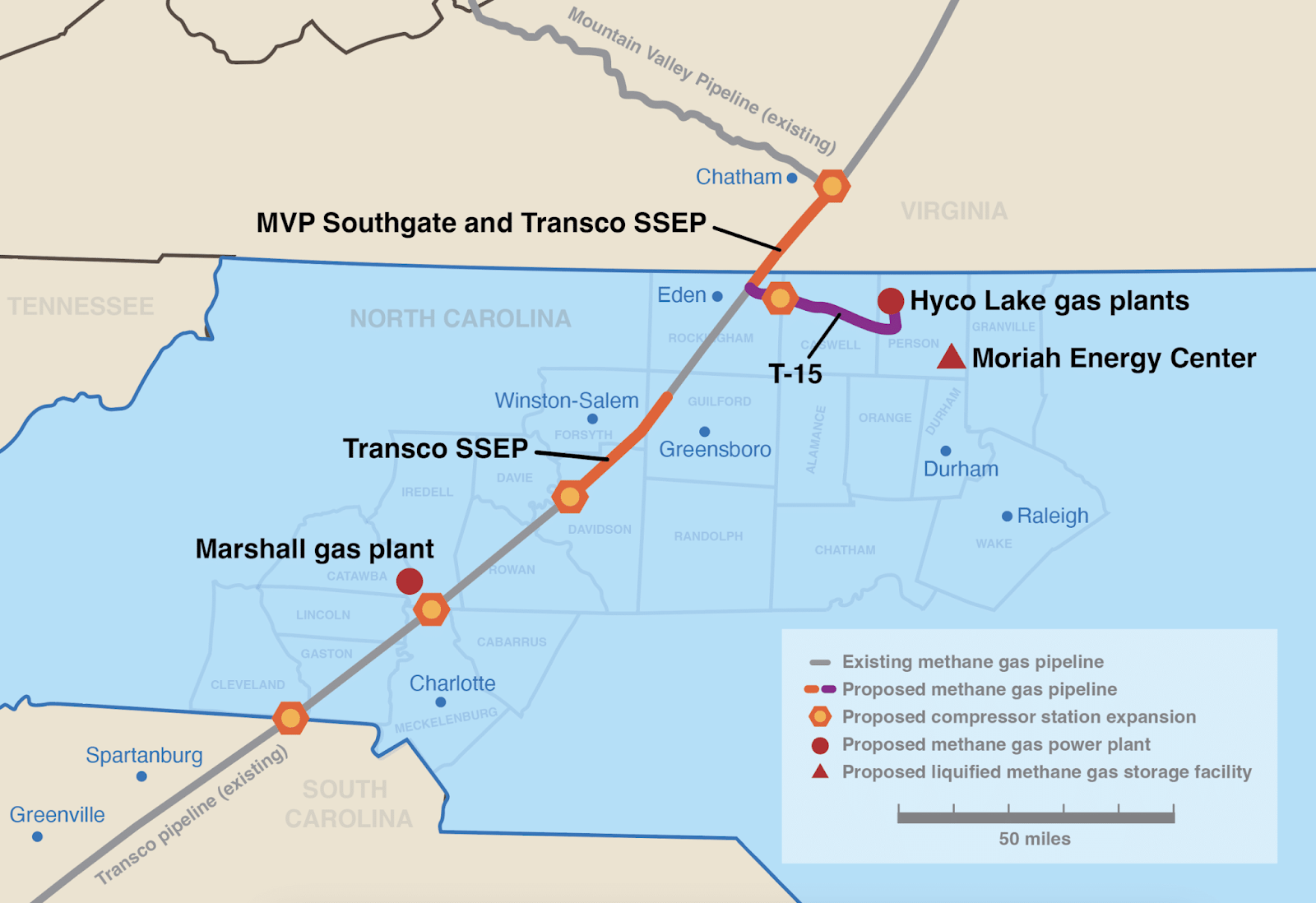
Photo Credit: Appalachian Voices
 The Salemite- Salem College's Newspaper
Leave a comment