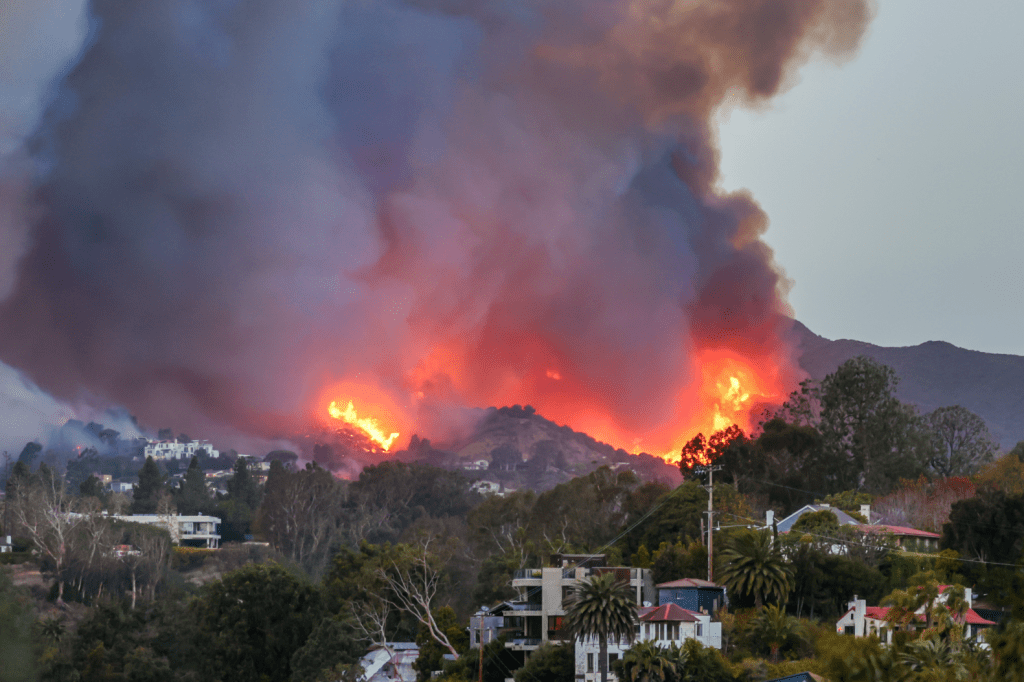
By: Clare Buchanan
On January 7, the day of my red-eye flight to London, I was awoken at 3 o’clock in the morning to the terrorizing sound of the entirety of my backyard being lifted and thrown up against my bedroom wall. I peeked through my blinds to see the palm frans of my neighbor’s tree bent completely sideways, struggling against the unpredictable torrent of the wind that had come down from the canyons. Large clay pots of succulents that weighed anywhere from forty to seventy pounds were rolling around the side yard like bowling pins. Lawn chairs flew around in the air and were thrown down the hillside carelessly.
Santa Ana likes to make a grand entrance.
The Santa Ana winds bring chaos to Los Angeles every few months, at odd and unforeseen times throughout the year. There is no set “wind season” in Los Angeles. Wind season is whenever Santa Ana wants it to be. Joan Didion wrote an essay about the Santa Ana winds saying, “I have neither heard nor read that a Santa Ana is due, but I know it, and almost everyone I have seen today knows it too. We know it because we feel it.”
The night before January 7, the air was eerily still. The coyotes had retreated from their burrows in the hills and were scavenging for water in the stucco apartment complex’s swimming pools. On my nightly walk, a coyote crossed my path, staring me down with its yellow eyes. I stood still and let it pass. It roamed around the street, looking back at me, before scurrying underneath a chain link fence.
The coyotes come down to the foothills when the winds are coming. They know fire is soon to follow.
When I was in primary school, the Los Angeles Fire Department visited my class once, and explained to us, ages 5 and 6, that a brush fire fueled by the Santa Ana winds could engulf our entire classroom in less than five seconds, leaving behind nothing but ashes and bones. By the time I was in high school, I had seen my fair share of wildfires. I had sat on my balcony at ages five, eight, thirteen, and fifteen and watched the flames lick the tips of the hills, barreling down the dry brush with the confidence of a hellish calvary.
To live in California means to live in a constant state of adaptation. Our environment is constantly changing based on if it is a wet year or a dry year. Steinbeck wrote in East of Eden of the beauty of the hills during a wet year, the lupines, poppies, and wild mustard often bursting in superblooms, more reminiscent of a mystical land like Oz than the real world. Out of my seventeen years spent in Los Angeles, I can only remember four, distinct wet years. In contrast, the dry years bring drought, dust, and damnation to Southern California. The hills are a constant shade of pale, murky brown. The smog lingers in the hot air, suffocating natives and tourists alike. The dry years bring hot winds and wildfires.
2023 had been one of those sacred wet years. Unprecedented amounts of rainfall had resurrected the chaparral and small creeks had run down the hills, feeding the mustard and poppies on the ridges of the verdant hills. Then 2024 came, and the rain deceased. Plants shriveled and decayed. And the fear of the winds returned.
The afternoon of January 7th, as my mother drove us down the 405, towards LAX, I looked towards the left side of the highway to see the hills of Topanga Canyon completely engulfed in flames. The smoke billowed over the tops of the hills and invaded the highway, causing a cyclone of ash and debris to twist and turn between the cars stacked like sardines in traffic.
“I guess I’ll have to take the 134 onto the 2 when I head home.” My mother said casually, as if deciding against a sandwich for lunch, opting for a salad instead. My mother is a Los Angeles native. She knows that if it’s not the fires, it’s the earthquakes. If it’s not the earthquakes, it’s the landslides. And sometimes, it’s all three, since earthquakes tend to trigger both fires and landslides.
As is characteristic of my relationship with Los Angeles, I left in a fury, angry at this city for its impossible nature. The next morning, I was in London, sitting on the edge of my hotel bed, watching the local UK news. The headline read: “California Is On Fire”, which was both true and untrue. Los Angeles was on fire. The rest of California was fine.
A British lady reporter pronounced Los Angeles “Los Angeh-lees” and I almost laughed.
But there is nothing really funny about watching your hometown burn from a television screen 5,000 miles away, is there?
As the Palisades fire roared onward on January 8, the Eaton and Hurst fires encroached on my homestead at the foothills of the San Gabriel Mountains. My parents looked outside their window and saw orange skies and ash floating through the air, a hellish, California snow. On a bus to the East Midlands of England, I watched on CNN my homestead highlighted in red signaling an evacuation order had been put in place. National and international headlines on the Los Angeles fires will tell you which Hollywood celebrities lost their 10 million dollar homes. I have hopes the world will also come to understand that communities of humble and hard working people have also lost entire communities, and don’t necessarily have the resources to build it back. While the loss of the Palisades community in Malibu is felt, the loss of Altadena, a historically Black neighborhood in Los Angeles where Jackie Robinson once lived, is also felt greatly. People are being told not to go outside for fear of carcinogens like asbestos are now floating through the air. Schools and churches are gone. Where does one go from here?
Many people have said these fires are a result of climate change. However, there is a difference between the broader effects of climate change and the unfortunate, yet predictable, results of human beings thinking they can escape the power of Mother Nature. While yes, these fires are unprecedented and likely exacerbated by the effects of global warming, Southern California has always burned. The Santa Ana winds happen naturally from increased pressure in the north canyons of the Great Basin, and spark healthy fires that rejuvenate the chaparral and erase the accumulation of dead plant matter in the hills. The mistake that humans make is thinking they can build their 10 million dollar homes in areas that have to burn. Mother Nature will not divert her fire and winds around the Hollywood Hills just because she’s feeling kind. This latest bout of fires has revealed the catastrophic and devastatingly arrogant urban planning in Los Angeles. Where other cities like Seattle have learned to build around nature, to find ways to plan neighborhoods that suit the environment, Los Angeles has been built since day one with the goal to conquer and squander nature. And now, she’s fought back.
They say you can always find your way back home. At age nineteen, I know this isn’t true. Maybe it’s the constant mutation of Southern California, or the consistent adaptation of the Los Angeles chaparral, but every time I come back, the environment seems to have changed. Usually it’s the addition of yet another shopping mall or Starbucks, but now I wonder, when I return from my latest endeavor in the UK, what streets will look the same, and which will bear the stress of the relentless Santa Ana flame.
 The Salemite- Salem College's Newspaper
Leave a comment