By: Chloe Snow
Photo Credit: Vanity Fair

Photo Credit: The Guardian
“A Complete Unknown” Movie Review: “A Complete Unknown” Provides a Dazzling, Synchronic View of Bob Dylan’s Early Years
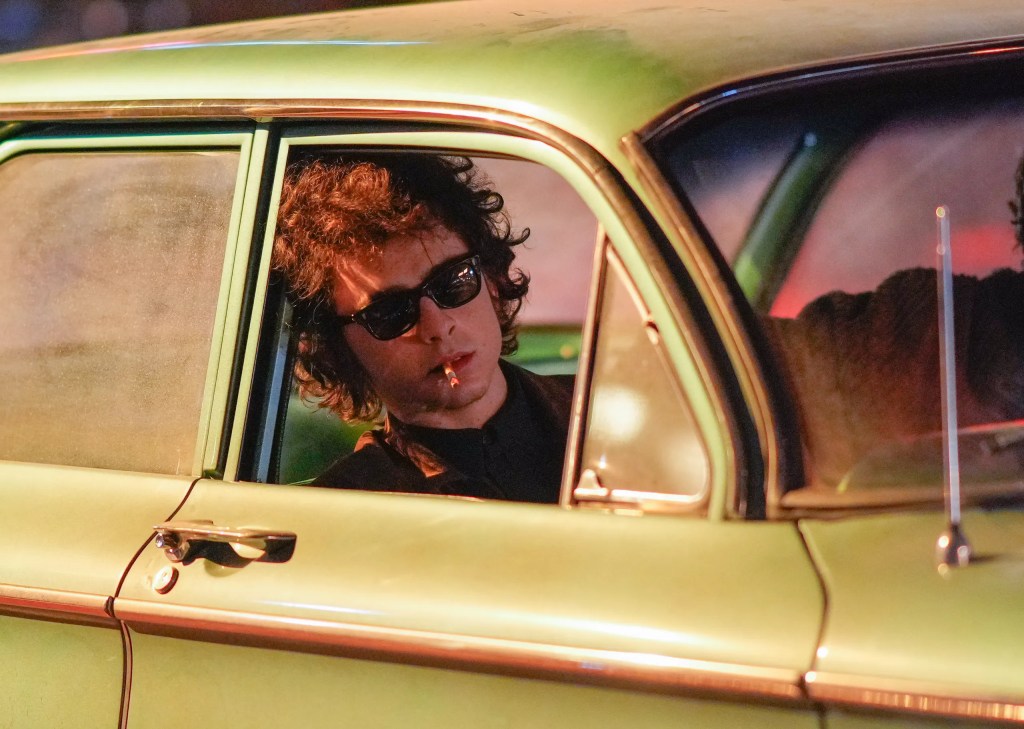
“A Complete Unknown”—the title inspired by Bob Dylan’s song “Like a Rolling Stone” (Forbes)—starring Timothée Chalament, Elle Fanning, and Edward Norton opened in theaters Christmas Day. As of Dec. 29, 2024, the film is 79% fresh on Rotten Tomatoes with a 96% Popcornmeter rating (Rotten Tomatoes). The film has received mixed media attention. David Rooney writes that the film was carried by superb music sequences and incisive performances (The Hollywood Reporter). Mark Kennedy writes for the Associated Press “A Complete Unknown” is utterly fascinating, capturing a moment in time when songs had weight, when they could move the culture — even if the singer who made them was as puzzling as a rolling stone (Associated Press). Others have less than glowing reviews. Spencer Kornhaber from The Atlantic says that no movie about unconventionality should be as blandly conventional as this one is (The Atlantic). While the reviews are broad, I found the movie to be quite entertaining. Even more entertaining than the film, however, was the conversations before it.
Pre-Screening Conversations:
On Christmas Day, at the a/perture cinema in downtown Winston-Salem, I settled into a mid-row seat among baby boomers, Gen Xers, and even some Gen Zers. Prior to the start of the film, this distinct conglomerate created and established a collective narrative about the 1960s onward. Listening to pre-screening conversations was as enlightening as the film itself. From a group of women discussing burning their bras to one woman remembering a trip to the site of Woodstock to men recounting the glory years of the 1980s, to gaggles of girls discussing Timothée Chalamet, the variety of discussion made me lean in and really listen.
Focusing on the group of women who recounted their Woodstock years, one woman made a striking comment “We never achieved parody.” She said that they (assuming “they” to be the young people of the 60s) believed that they could achieve so much, though she commented she was both discouraged and frustrated with their generation of having failed to do so. What she meant by “parody” however is left uncertain, but what seems clear is a collective mentality and a shared belief among these women of having somehow “failed” despite dreaming big. Her raw nostalgia followed me into the film. Although the scenes, the setting, the clothes, and the hair were quite nostalgic and made me wish for a time before this one, I also remembered that no period in the past was blissful. The 1960s especially was world-changing, and it changed quickly.
Image credit: IMDb

Overall Perspective
Overall, the movie provides a dazzling, synchronic view of Bob Dylan’s early years. In other words, the film focuses on a particular moment in Dylan’s life and the context in which he and his music are situated. Without going so far into Dylan’s past nor his future, the movie sticks to its purpose of presenting an allusive artist. One critic says that Dylan remains a mystery. Dylan is an observer, using everything as material, furiously typing on his typewriter as he channels whatever thoughts and lyrics are moving through him (Arizona Republic).
However, I would add that Dylan is not just a passive observer. Artists both shape and are shaped by the context surrounding them. As his popularity grew, Dylan was an active shaper of the changing world around him. Another critic says that it is not that the movie tries and fails to help us understand Bob Dylan; on the contrary, it recognizes that Dylan defies that kind of simplification (Movie Mom). As we try to name what Dylan is and is not, we trap ourselves in trying to describe him. Ultimately, the movie does not do this: Dylan is never perfectly presented as being “one thing.” Rather, his music helps to create a collage of an artist’s early life. Chalamet, particularly, was excellent in playing the allusive singer, creating an image of Dylan without pinpointing exactly who Dylan is.
Image credit: IMDb

Enduring Themes
Without giving too much summary, Dylan moved from singing traditional “folk” music in the early sixties to collaging new sounds in the mid-60s that included more rock and blues influences. Of course, any sort of change is met with chaos simply because it’s different. The themes of change and “difference” support the film’s central questions: who are you and who do you want to be? We see by Dylan’s evolution from folk to a new sound entirely that there was always an interest in change. Therefore, being unknown is not that one isn’t known, but being unknown is being made different. This is true especially in the 1960s when making a difference was part of the everyday narrative, therefore it is appropriate, and even normal, for Dylan’s music to evolve as the entire world changed as well.
Ultimately, the movie was good, the soundtrack was great, the actors were exceptional, and the pre-show discussions were an added bonus. I will gladly give this movie 4.5 stars out of 5. In a lasting thought to respond to the lady at the theater, before we see any difference, we may ask, in the lyrics of Bob Dylan’s “Blowing in the Wind,” “How many roads must a man walk down / Before you call him a man?” Before we see the impact of change, we may ask ourselves “How many ears must one man have / Before he can hear people cry?” Dylan would tell us the answer is blowing in the wind. Maybe it is. I can say that the only failure is to do nothing at all. And we won’t do that, will we?
With that being said, I will now plow through all of Bob Dylan’s albums for the rest of break.
 The Salemite- Salem College's Newspaper
Leave a comment